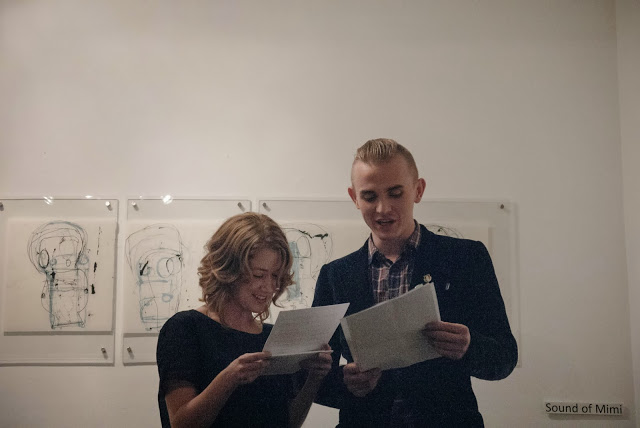
An interview with the Poetry school for my upcoming course Maintenant
http://campus.poetryschool.com/maintenant-interview-s-j-fowler/ Text below taken from the beautiful Campus layout the Poetry School has set up, very generous interview on their part...
Has any other poet thrown himself into curating and collaboratively creating contemporary poetry with the same enthusiasm as S J Fowler?
Publishing five collections in three years is an achievement in itself, but there’s also something admirable about the way he draws other artists and poets into his creative orbit, whether that be by collaborating with them as part of his Enemies project, (which culminated in the Enemies book, published by Penned in the Margins), publishing them in 3:AM Magazine, or interviewing them for his Maintentant series, now almost at a hundred articles. Students on his spring term course, also called Maintenant!, will become part of his collaborative circle, writing poems inspired by key 20thcentury experimental poetry movements and performing them at an end of term reading. We asked Steven for advice on exploring experimental poetry and collaborating fruitfully…
Your course will be covering Oulipo, Austrian postwar modernism, concrete poetry, CoBrA and the British Poetry Revival. Can you explain how you came to be interested in these movements?
S J: I think because I came to poetry quite recently, only four years ago really, and very much fell into it, my reading habits, my influences, are not really formulated along formal lines. I wasn’t handed classical poetry as a child, didn’t listen to whatever was taught at school, didn’t grow up valuing a certain tradition or style or form, I have just read continuously, whatever I could where I could. For years I was completely isolated in my reading too, being led into it by philosophy, which I studied, and as such I was in a bubble, didn’t have the chance to develop any sense of prejudice against poetry in translation, or avant garde work, as somehow otherly. That’s perhaps why I read this kind of work alongside poetry that might be better known in this country in equal measure.
Moreover, each movement that I’m going to be covering in the course has its own special place in my own development as a poet. The Oulipo showed me how structural freedom can actually be more restricting than formal structures and concepts, because that freedom is mediated by very specific influences and tropes. Austrian postwar modernism is the example par excellence of avant garde writers writing for a purpose, and not as a self-indulgent stance against something, and that is to expose the ever present instincts of fascism in a nation that had tried to plaster over in immediate history and responsibility. Concrete poetry showed me that language is not mediated only by its content, but by its appearance, by the material it appears on – it has multiple dimensions, it is art as well as language. CoBrA really exemplifies the very best of what post-war European poetry aims to achieve – collectivity, collaboration, dynamic experimentation. And the British Poetry Revival, well this was a seismic discovery for me. An entire legion of incredible writers, writing about my country, writing works of genius, completely hidden from the mainstream reader.
In the course description it says that the techniques used by the poets you’ll be covering can, ‘compliment, rather than antagonise, more formal writing practice’. Could you expand on what you mean by that?
S J: I think there’s a territorial, self-defeating dualism that seems to permeate through people’s perception of the experimental, that it requires a philosophical or political praxis to be part of their writing. That it is against something, more than it is for something. This isn’t true, fundamentally. Experimentation is about finding the authentic way to express a very certain content. And that’s why a lot of formal poems fail in my opinion, because they are using the wrong form, because it is familiar or it is all the writer knows, to express their content. I hope to just humbly, gently, suggest that these movements show us new worlds of form and method toward content we might want to access and express.
You’re responsible for the Enemies collaboration project – will you be encouraging poets to collaborate on this course?
S J: Absolutely. It is wholly beneficial for any poet to engage in collaboration in my opinion, it allows one to step beyond one’s comfort zone, it forces the poet to be generous and generative and it mediates sociality beautifully, through the creative act. Plus you can blame failures on the other person! Best not to say this out loud of course. I hope the class will be defined by an atmosphere of communication, exchange and that the collaborations will be utterly organic, the genus being in the shared new ideas and discoveries which happen for everyone in the room.
In the Enemies book, was it a purposeful decision not to demark whose contribution is whose in many of the projects? What effect do you think this has?
S J: It was, and in the most instinctual way, this was primarily to commit to the work as a wholly new thing, a child of two poets, and not the spliced remnants of two individuals. So much of the poetry in Enemies, I really can’t remember whose line is whose. This is the most beautiful rediscovery, to have given so much to the style and brilliance of another writer that you and they are entwined in the work toward the same goal. I hope the effect of this is for readers to be taken by the content and not the authorial presence, which is often an obscuring force, a context we can rarely remove.
Why do you think collaborations succeed or fail? Do you have any tips for successful collaborating?
S J: It’s all about generosity as a mode, about perspective, and I think it goes right to the roots of one’s view on aesthetics, on poetry and its purpose, and one’s view of communication. If you see poetry as a reflection of your external experiences, internalised through the unique nexus of your millions of experiences and emotions and knowledge, then the act of collaboration is replacing the stimulus of your life with the specified stimulus of another human being, and their unique way of refracting the world. It becomes very easy to allow this to move you. If you see poetry as the effect of a muse like inspiration on your defined subjective soul or being, then you’ll probably want to protect that ‘inspiration’, and you won’t be so free to share, sacrifice and risk. Collaboration is all about generosity, it is an act of giving, a process of sacrifice.
When you collaborate with an artist, is it always a case of the images already existing and you responding to them, or have you worked in other ways?
S J: Every collaboration has been completely different. I’ve perhaps undertaken about 70 different collaborations to date, across every medium I could, and each time I try to get the collaborator to build the process with me, and to let them begin. I worry I can be a demonstrative person at times, overbearing, so I try to impose a deference upon myself when collaborating, and so far, it seems to be a good instinct. With visual images, photography and art as the like, often it does become tennis, but as often as not, it is my poems which generate their art, as well as their images generating my poetry.
I’ve always struggled to write poems that respond to visual images, do you have any advice for poets who want to respond to visual art in an original way?
S J: Being fidelitous to the grammar of visual images can’t be literal. One has to be familiar with the process of the artist or photographer, even if in the most material or shallow manner, and then, most importantly, what their intention is. Often the physical result does not achieve the intention for you, or for other viewers of the work. But if one then approaches that intention from your own poetic, your own abstract understanding, then a natural kinship will develop. I think so anyway. Museum of Debt, which is in Enemies, features portraits of museum workers by Alexander Kell, and Alex and I had both worked at that Museum, we didn’t even need to talk, we both created at the same time, with no dialogue, and the images and the poetry is imminently fused. It is about boredom, about the quiet desperation of a job that leads nowhere. The subject spoke, our intention was entwined.
Tell me more about the event that your students will have the opportunity to read at…
S J: It’s a very exciting programme. Three of the most innovative poets in Europe, Cia Rinne, Morten Sondergaard and Martin Glaz Serup will be visiting London for a week, for events with Rich Mix arts centre, in Brick Lane, and for an exhibition at the Hardy Tree gallery in Kings cross. The Danish agency for culture are supporting the venture, called Fjender, part of my Enemies project. They will be collaborating with myself and two other British based poets, and thanks to the Arts Council here I will be visiting Copenhagen to read our collaborations in Denmark too. The students will get to read on the big night in London, share some of their work with those poets and the public, if they want to.
Can you think of any good anthologies our students could buy to familiarise themselves with some of the poets you’ll cover? Or any good sources of information online, (aside from your wonderful Maintenant series of interviews)?
S J: Certainly, I can never speak highly enough of the Poets for the Millenium anthologies, by Jerome Rothenberg and Pierre Joris. Get the first two volumes. Mind blowing, the scope and the width of the poets and the superlative editorship, this is what anthologies should be. Online, check out www.lyrikline.org. Quite formal poets, but a great resource for translated work across languages. Also Ubuweb, if you haven’t been on there, well that’s a good ten years of material for all of us.
If you think you could do with catching some of Steven’s contagious enthusiasm, you can book your place on Maintenant! online, or call 0207 582 1679.
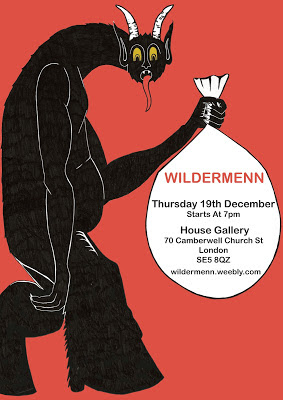
Wildermenn exhibition at the House Gallery, Peckham
the
premiere exhibition of the Wildermenn collective, beginning December 18th
and closing just before Xmas, will take place at the House gallery in Peckham, London.
http://www.house-gallery.co.uk/
Wildermenn combines visual art, poetry, sonic art and sculpture into one wholly
collaborative art collective about urban transhumance. http://wildermenn.weebly.com/ https://twitter.com/wilder_menn The exhibition is curated by Gabrielle Cooper.
A special
view and performance evening will take place on Thursday 19th, doors
opening at 7.30pm, entrance is free. It will be an unforgettable evening of
organic mush and destruction. Please come along, a poster attached.
2 Incidents of Anti-Semitism in the Bohemyth
The Marquess estate for Ejecter
im a bit of a pretentious twat in this one, but they wanted it all mooody. for the Ejecter series by Andy Niblo, shot up in Edinburgh in September. This is the last poem in the Estates of Westeros series, published by Like This press, illustrated by Ben Morris.
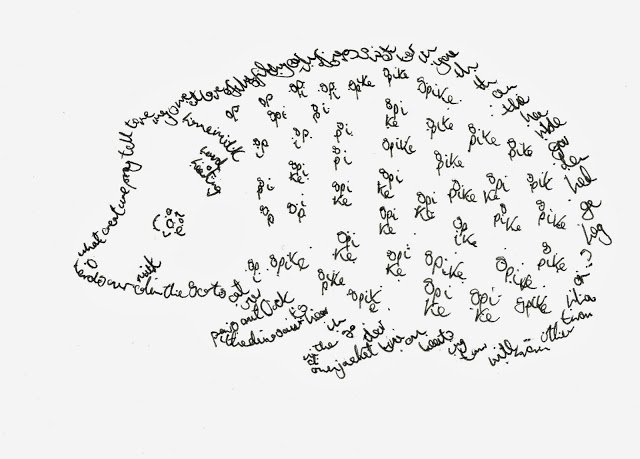
5x7 group show at the Hardy tree in December! my animal calligrams for sale
Very excited to be in the latest group show taking place at the Hardy Tree gallery, running for three weeks across December. The concept is that around 15 artists provide 15 artworks around postcard size, which are hung in the gallery and sold for 25 quid each.http://hardytreegallery.com/
My 15 artworks are all original calligrammatic representations of animals. Each one is essentially a drawing of an animal in handwriting. Ive played with Calligrams for awhile, pretty much directly following Apollinaire. I've deliberately made them somewhat illegibile, so the handwriting, in places, allows for multiple, interpretative readings of the poems. They are all poems, pre-existing poems, written for the calligram, which will never see the light of day in their non-calligrammatic form, but I want the search for the meaning to be primary in the readers experience. The reader can make their own poems as they have to fill in the gaps between what is legible to them and what is not. Each time the poems are read, they are anew.
& Erkembode is also in the group show, my frequent collaborator and continuous inspirator. His work includes originals from our collaboration, Jurassic Strip, about Jurassic Park in the middle east. All the poems and paintings in this collaboration have been published as an ebook to be viewed for free belooow.
Cristine Brache - Monger Tours
http://mongertours.com/ an incredible representation of the work of Cristine Brache, the homeland of international ballers, all housed up in annn website. the interplay between text, image, net tech and the actual tonality of the engagement with the grime of the international fluid scene is remarkable. especially priding to me is this piece, http://mongertours.com/iknow.html, which includes lines from my poems. Click through all the chapters, watch the videos, all amazing poetry art video.
Penned in the Margins Xmas sale - Enemies in the Innovator package!
Christmas Bundle #1: The Innovator
I'm not just saying it because they published Enemies, but Penned in the Margins is clearly one of the most important poetry presses in the British Isles. The list speaks for itself (Wilkes, McCabe, Critchley, Kennard, Phillipson et al), always innovating upon their own mode. And now they're having a Christmas Sale - 20% off all books until the end of December. http://www.pennedinthemargins.co.uk/index.php/2013/12/great-deals-on-poetry-and-experimental-fiction-in-our-christmas-book-sale/ & add into this there are special bundle deals, the first of which, includes Enemies, so get out your 25 squid and improve your life.

Books for those with avant-garde tendencies. From Emily Critchley’s experimental confessionals to the minimalist lyrics of Rob Stanton, and from Alan Cunningham’s urban philosophy to SJ Fowler’s cross-artform collaborations, this is poetry and fiction that embraces fragmentation, collage and collaboration £25
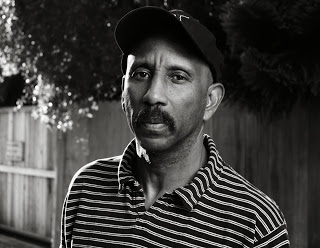
it remains sonic occultation - an interview with Will Alexander for 3am magazine
http://www.3ammagazine.com/3am/interview-will-alexander/ Any lineage one might trace to the poetry of Will Alexander could only be made up of those who defied formal influences – originators – Will Alexander is firmly in the tradition of the pioneer. More than that, more than just being original, he is authentic. And more than just being a resonate, profound, distinct voice in American poetry over the late 20th and early 21st century, his poetics are so grand, exponential, luminous and visionary, that his singular voice, unmistakable as it is, is the all the more remarkable for its rootedness. No less than expanding beyond consciousness, beyond prosaic dimensions of language and understanding, his praxis is exploration – through art, physics, botany, history, astronomy, architecture, all becomes poetry, mulch for refraction through the poet, who is made up of the endlessness of language and experience. His is a poetry ever growing through the page, through the expectations of poet and reader and on into something else, which cannot be so easily defined or described, lest it not be poetry. To celebrate his visit to the Contemporary Poetics Research Centre, Birkbeck college, London, to share his work with European audiences, we present an interview with Will Alexander.
3:AM:A profound achievement of your work I think is to make an identity purely through your language and its content in flux, rather than the positing of your own authorial presence. Many achieve the occlusion of the authorial identity, but few are able to form something that takes its place through the sheerness of their work, through the language becoming its own identity. Is this an active process in your writing?
Will Alexander: To say it succinctly language is life and life being motion what follows is the intuitive understanding that creative language cannot be plotted by contiguous, or what I would call verbal architectural planning. For me it is suffused with explosive electrical motion, wayward, encyclopedic, seismic – alive by means of seeming disorder. Which does not allow for the controlling posture of “the author”, anchored as he or she is by extrinsic classification....
plus a poem, original to 3am magazine, a Nexus of Phantoms http://www.3ammagazine.com/3am/anexusofphantomswillalexander/
Pictures from Poets as Saints by Alexander Kell
an interview on collaboration for the inaugural issue of the Learned Pig

The Learned Pig: People often talk about “the collaborative process” as if it were a single, monolithic approach. I’m assuming, from the diverse results evident in Enemies, that collaboration took on many different forms. Could you talk a little about the different ways of working with so many different poets?
SJ Fowler: The possibilities of exchange are as exponential as the forms of exchange, as endless as the possible subject of the collaborations, and their content. I think that’s the reason why my collaborations didn’t stop after working with a few people, why they haven’t ceased now, even though the book is out in the world. Collaborating sits beside the normal writing process, not within it, as a practice in and of itself.
I do think, generalising horrifically, that collaboration does require a certain perspective, or some shift in perception, to be successful, and one that is quite fundamental to the participants’ view of their work, and of aesthetics in general.
At times, no critical discussion would take place, in other instances it would involve a form of mathematical rigour. The real genus of the work though was how we spoke to each other, how we positioned ourselves together, perhaps against our other works and working methods. Of course working with mediums outside of language completely radicalises those relationships and processes even further, as you’re truly adrift, and all the better, I would say, in that lack of familiarity.
TLP: What makes a “successful” collaboration? Is it about the process or the end-result, or both/neither?
SJF: For me it is entirely about the process. I do not feel comfortable in any situated objectivity when it comes to the end results, and more than that, quite fundamentally, I’m seeking out these collaborations because of what the process provides me. Which is a mediation of sociality through the creative act, a wholly communal engagement with a normally private process. I believe, more from the experience of organising and inculcating other people’s collaborations through my Camarade events, that if the process is generous and accommodating, it will also be inherently generative.
TLP: Have you experience of collaborations that haven’t worked at all?
SJF: Absolutely. It tends to be, and again massive generalisations here, because an artist / poet feels they must protect their work or their identity as an artist. To me, this is a counterintuitive idea, as collaboration is an innately generous process and anyone who volunteers to enter into it must assume they are going to have to say yes to ideas they might say no to if they were their own
I have often remarked on the temperament of collaborations in different geographical locations. In London, where I have collaborated most often, people are so under pressure financially they have to work to support their art practice. As such, the notion that they would regularly call themselves an artist or poet in the vocational sense, and take on the identity (often mythical as that is) is also rare. Their time is at a premium too, so they feel an immense pressure to use it, to justify to themselves the crushing work they have to do to pay the exorbitant rent. This means they work rapidly, roughly, and often. They are freer in collaboration, because they haven’t time to consider how it might reflect upon their identity as an artist, and they want to grow as much as they can in the little aperture of time they are afforded.
Outside of London, people are less prolific, less self-effacing and less adept at collaborating.
Other cities I’ve worked in, where people don’t have to work a full time job just to eat or live, or when I’ve worked with people who are funded students for example, there is a marked difference. The energy is lower because it can be, people have more time to theorise their own work, to situate it, and to consider their own identity in it, and by consequence they are less prolific, less self-effacing and less adept at collaborating.
TLP: Animals, and the human-animal relationship in particular, seem to be a running motif throughout the book. Could you talk a little about why this might be?
SJF: I think it’s more interesting, and generative, and pleasing to me, that it seems that way when there was no such intention. By no means was the theme of animals, or their relationship to humans, an overarching thematic of Enemies in a directed, cognisant way, as the book is a Frankenstein of works that span mediums as much as motifs. I think the book can and should be read as a Rorschach test, like Sian Williams’ beautiful inkblot artworks which make up the Animal Husbandry collaboration that sits quite prominently in Enemies. These reflect the thought processes of the reader rather than the author, just through (I hope) the ambiguity of the poetry (which is ambiguous in response to the ambiguity of its subject matter) and the scope of the collected works. Others have said to me themes of historicity, sexual violence, mortality seem to ever present throughout the book too. I suppose it reflects better on me that you saw animals everywhere.
Maintenant! a course for the Poetry School
I'm delighted to announce that in 2014 I will be teaching a course for the Poetry School http://www.poetryschool.com called Maintenant! exploring post-war & contemporary European avant-garde poetry.
The course will take place at the Poetry School London office, 79-83 Lambeth Walk. 2 hour lessons – 6.45pm to 8.45pm
Week One: January tuesday 28th – Oulipo
Georges Perec, Jacques Roubeau, Raymond Queneau up to Frederic Forte and British Oulippeans like Philip Terry. The constraints that emancipate.http://en.wikipedia.org/wiki/Oulipo
Week Two: February tuesday 11th – Austrian postwar modernism
Thomas Bernhard, Peter Handke, Elfriede Jelinek. How to deal with the legacy of Fascism. http://en.wikipedia.org/wiki/Peter_Handke
Week Three: February tuesday 25th - Concrete poetry
Hansjörg Mayer, Bob Cobbing, The Vienna Group, Oyvind Fahlstrom, Marton Koppany up to Anatol Knotek. The visuality of the poem as its meaninghttp://en.wikipedia.org/wiki/Concrete_poetry
Week Four: tuesday March 11th - CoBrA
Asger Jorn, Christian Dotremont, Pierre Alechinsky. Dutch, Danish, Belgian & beyond, poetry as art revolt & primitivism.http://en.wikipedia.org/wiki/COBRA_(avant-garde_movement)
Week Five: March tuesday 25th - British Poetry Revival
Tom Raworth, Bill Griffiths, Maggie O’Sullivan & many many more. Those every British poet should know, our immense late 20th century Vanguard heritage.http://en.wikipedia.org/wiki/British_poetry_revival
& near the end of the course, on March 15th 2014, at the Rich Mix arts centre, the students will get a chance to read some of the work they've produced during Enemies: Fjender, which explores contemporary Danish avant garde poetry in collaboration, with Cia Rinne, Martin Glaz Serup and Morten Sondergaard, who will also be exhibiting his remarkable Wordpharmacy http://www.wordpharmacy.com
You can download the entire Poetry School London programme here: http://www.poetryschool.com/resources/ps-brochurespring14-printerfriendly-3.pdf
& here is the interview series that inspired the course http://www.maintenant.co.uk/ all 97 editions so far.
Un amour si grand qu'il nie son objet / He got a reaction out te yeh, you have to give him that
PLAYATTHESAMETIME
a review of Enemies by for Annexe Magazine
http://annexemagazine.com/review-enemies-sj-fowler/
Enemies, recently published by Penned in the Margins is a collection of twenty-nine collaborations – ‘a record of friendship’, as SJ Fowler puts it himself in the introduction – that spans across all fields of language and poetics, from photography to illustration without limit in means of expression, so don’t be surprised if you find yourself searching videos on Youtube (Videodromes with Clare Potter) or reading (well trying to read, for some) a musical sheet ( see collaboration with Philip Venables, The Revenge of Miguel Cotto).
More importantly these twenty-nine pieces are an incredible collage in their own right. A collage that sweeps away all expectation by throwing you around from one experience to another without much time to breathe, but it’s worth it.
They are a testimony to the importance of sharing, taking risks, communicating and experimenting while pushing the boundaries that define poetry and even, the notion of collaboration itself. In Enemies we go from ‘simple’ poetry block exchange (see The Mechanical Root, or The ‘Burbs…) to referencing historical folklore with a contemporary twist like in Gilles De Rais where a parallel is created between the 15th century Breton knight and Jimmy Saville. Rich in intertexual and cultural references all over, it is literary poetry meet avant-garde linguistic disjunctions like in David Berridge’s collaboration, 40 feet, or the piece with Tim Atkins, entitled Secretum Meum, a re-writing of the Petrarch text which sees a dialogue between Petrarch and Saint Augustine; here the classic philosophy form is kept and yet subverted to create an amusingly awkward contemporary vernacular.
Amidst the sense of playfulness and inventiveness that this collection conveys, there are some pieces that stand out not just because of their innovative form and/or syntax, but also for their striking performative element, I’m talking of 1000 Proverbs, a collaboration with Tom Jenks and Long Letter, Short farewell, an exchange of emails between the poet Sam Riviere and SJ Fowler. They are amusing, clever and highly accessible compared to the mysterious connections that some of the other collaborations set within each other and the reader.
Enemies is an ambitious and ground-breaking publication where disciplines mingle in conversation with each other, finding new contexts; In SJ Fowlers’ words ‘experimentation and innovation is not a stance, but a pattern of behaviour, not a philosophy of theory, heavy with beneficial and smug associations of rebellion and kudos, but a specific reaction to a specific need or notion – a philosophy in action.’
The unnerving feeling that comes from this type of poetical assault, can only be seen as inspiring and, hopefully, as the spark igniting many more collaborations within the realm of the arts.
_____________________________________________________
SJ Fowler is a poet, artist and performer. His books have been published by Veer, KnivesForks&Spoons, Red Ceiling, AnythingAnymoreAnywhere and Penned in the Margins. He is the curator of the Enemies project and theEnemies book is published by Penned in the Margins.
Reviewed by Milou Stella.
Milou Stella is an artist, writer and co-founder of Witches of Odd. Her pamphlet, Meander is published by Annexe.
Poets as Saints - Erkembode exhibition reading
Sarah Kelly - https://www.youtube.com/watch?v=Ylug5cVA81I
Marcus Slease - https://www.youtube.com/watch?v=3073DcMsjI0
Tim Atkins - https://www.youtube.com/watch?v=rbpK4XxtZe8
David Berridge - https://www.youtube.com/watch?v=rbGOlqN9dgk
Held at the Hardy Tree gallery in Kings X, London on November 23rd 2013, for the Erkembode: not just another saint exhibition, a series of poetry readings from contemporary British vanguard poets who have collaborated or worked closely with the artist David Kelly www.erkembode.com including poetry from Marcus Slease, Holly Pester, SJ Fowler, David Berridge, Robert Kiely, Tim Atkins & Sarah Kelly.
the introduction to Enemies published by Penned in the Margins
http://www.pennedinthemargins.co.uk/index.php/2013/11/a-miniaturised-bulkwark-against-being-solitary-sj-fowler-introduces-enemies/
‘A miniaturised bulkwark against being solitary’: SJ Fowler introduces Enemies

Steven Fowler (right) with friends
We’re born alone, we live alone, we die alone. Only through our love and
friendship can we create the illusion for the moment that we’re not alone.
- Orson Welles
First and foremost, this book is a record of friendships. It is a testament to my refusing to be alone in the creative act, as I would not want to be alone in the world, and to my decision to mediate sociality through the artistic impulse of other human beings, whose brilliance leaves me feeling more at home in that world. If my daily life is primarily defined by individuals who have decided to make their brief time on this planet one of creativity, ingenuity, intelligence and humour, and who have talents far surpassing my own, my experience of life can only be one that is defined by constant growth and learning and, hopefully, understanding — towards nothing more than more art unto expiry. Maybe even enough to temporarily blot out life’s adversarial character and essential purposelessness. Certainly it has worked recently, and that’s more than enough for me.
This is why the book exists as selected collaborations, whittled down from over 60 different exchanges I have been a part of over the last few years with writers, poets, artists, photographers, illustrators, designers, sculptors and filmmakers from across the world. The act of collaboration has become a defining turn in my practice, a constant affirmation of a way of writing as well as a way of communicating in real space, between human beings.
Enemies is a record of potentiality too, of what the aberrant and ambiguous use of language can be when responding, warping and enveloping another, equally abundant, artistic medium. It is my view that poetry lends itself to collaboration as language does conversation, and it is in poetry we are renovating the living space of communication, and this in itself is a collaborative act. The poet comes up against something other than themselves in the writing of every poem; and in the shaping of every fragment of language there is a response taking place. I hope this book showcases original, dynamic examples of what is produced when the other in question is the equally avid mind of another artist or writer.

Artwork from Enemies by photographer Alexander Kell
The motivation behind my taking on so many collaborations was initially a source of uncertainty for me. I’ve come to realise this reluctance (I began collaborating by invitation, the Voiceworksand Blue Touch Paper projects being early examples) is intensely important. It’s becoming clearer with time that I undertake so many collaborations precisely because, at heart, I believe less than many of my peers in the transformative power of poetry. That isn’t to say I believe poetry isn’t transformative at all — of course I do ascribe it such potential (to me personally, it is utterly and immensely transformative — but I refuse it the power to go beyond my own personal subjectivity. I refuse the idea that poetry is improving in and of itself. There is a tension here, maybe even a paradox. I have both feelings at once, that poetry is both nothing and everything. Yet I do believe, somehow and without articulation, in the Brodskyite notion of poetry being the most important artform because of its relationship to the profundity of language, because of its engagement with what fundamentally constitutes all other creativity and discussion. It is impossible for me to escape the feeling that this relationship is wholly individuated, and so at the very same moment — poetry is nothing, a game for the initiated, the distraction of a select. I suppose then that my poetry, and my collaborations, are about stripping away a glib assumption that poetry is profound, to get to the private meaning, which I do believe is utterly closed and personal though very much present. Here is the second paradox: by maintaining a creative practice often reliant on an other, and an act of exposure toward them, I am able to gain fresh and invaluable access to my own poetry and its process. Paulo Friere’s notion that communication builds community in the creative, organisational act which is the antagonistic opposite of manipulation, and a natural development of unity, ties into the idea that my collaborations might be founded on a central turn — a paradox of dismissiveness and legitimacy about the poetical act and the nature of poetry’s power. For me then, this book is a confusion as well as a testament, a symbol of community and accord, as well as a record I cannot fathom on rereading. And this is exactly how it seems to me it should be — lost in the margins.
If this book is held together by poetry, it is as a soft and tacky kind of glue – uhu – as good for eating as for adhesion
Artists who are powerful alone, and need not collaborate, seem to do so easily, uninterested in the protection of their inspiration. If this book is held together by poetry, it is as a soft and tacky kind of glue — uhu — as good for eating as for adhesion, barely keeping pace (which is its strength, I hope, that it acknowledges this in its very firmament) with the photography, art, illustration, musical composition and design of so many gifted others to be found within these pages. I have been told it is a book dense and mysterious, full of challenging material, and shifts in tone. It doesn’t seem so to me, nor did it feel so in its multifarious creation or compilation. But then perhaps that is because I hope that if my work stands for one thing, it is that experimentation and innovation is not a stance, but a pattern of behaviour, not a philosophy of theory, heavy with beneficial and smug associations of rebellion and kudos, but a specific reaction to a specific need or notion — a philosophy in action. How might I express what I wish to outside of atypical methods? This I do not know, interested as I am in the untameable and almost unknowable, and the dark edges of experience, emotion, civilisation and its history. Broken syntax, free verse, Oulipian codas, found text, unconscious writing, high conception &c.: these are what I deem the necessary tools and, as I hope will be clear throughout this volume, ones wholly symbiotic with the subject of each collaboration and the work of each collaborator.
Steven Fowler with Holly Pester in Mexico on the Day of the Dead
The twenty-nine works ahead of you are almost always excerpts from larger works. At the end of the book you will find a Notes section, which will shed some light on the content and process of each collaboration, and where you’d find them in their full length, if relevant. I want to thank all the collaborators who made it into the book, all those who didn’t, probably better off not being associated with me, and Tom Chivers, editor of Penned in the Margins, who does important work, selflessly and with immense professionalism. Special debts of gratitude to Jon Opie and Shonagh Manson at the Jerwood Charitable Foundation, who, alongside Arts Council England, have allowed the concept for this book to grow into a huge programme of events and undertakings involving over thirty happenings and two hundred artists and poets. And to David Kelly and Livia Dragomir, monsters who cannot be unmentioned.
Consider this meagre work in your hands a rather miniaturised bulwark against being solitary — a sandcastle before a tsunami, that might provide you with the smallest apertures of pleasant distraction. For my own part, if my work sits alongside, or inside, work of a quality such as I hope you will find beyond this page, it can only be elevated. The others who are my Enemies in art and in life, who make up my community, and who will not let me be complacent, are what this book means to me. I hope for you it might take on another meaning that I cannot possibly fathom from my privileged vantage.
SJ Fowler, September 2013
Will Alexander reading at Birkbeck, London - Dec 2nd
Birkbeck Contemporary Poetics Research Centre is delighted to welcome Will Alexander. A rare chance to hear him read in London. Monday 2 December, Keynes Library, 43 Gordon Square, WC1, 7pm. All welcome.
Los Angeles poet Will Alexander works in multiple genres: the novel, essay, aphorism, play, philosophy, visual art, and music (as pianist). His influences range from poetic practitioners, such as Aimé Césaire, Bob Kaufman, Andre Breton, Antonin Artaud, and Philip Lamantia, to the encompassing paradigm of Sri Aurobindo’s Integral Yoga, and the Egyptian worldview as understood by Cheikh Anta Diop and R.A. Schwaller de Lubicz. His work explores the fields of art, physics, botany, history, astronomy, architecture, and poetics, amongst others. Alexander’s books include Kaleidoscopic Omniscience, Asia and Haiti, The Sri Lankan Loxodrome, Compression and Purity, Sunrise In Armageddon, Diary As Sin, Inside the Earthquake Palace, Towards The Primeval Lightning Field, and Mirach Speaks To His Grammatical Transparents. His collected essays, Singing in Magnetic Hoofbeat (Essay Press, 2013) received an American Book Award from the Before Columbus Foundation.
Festival Expandible in Mexico City - the showcase performance - Holly Pester & I
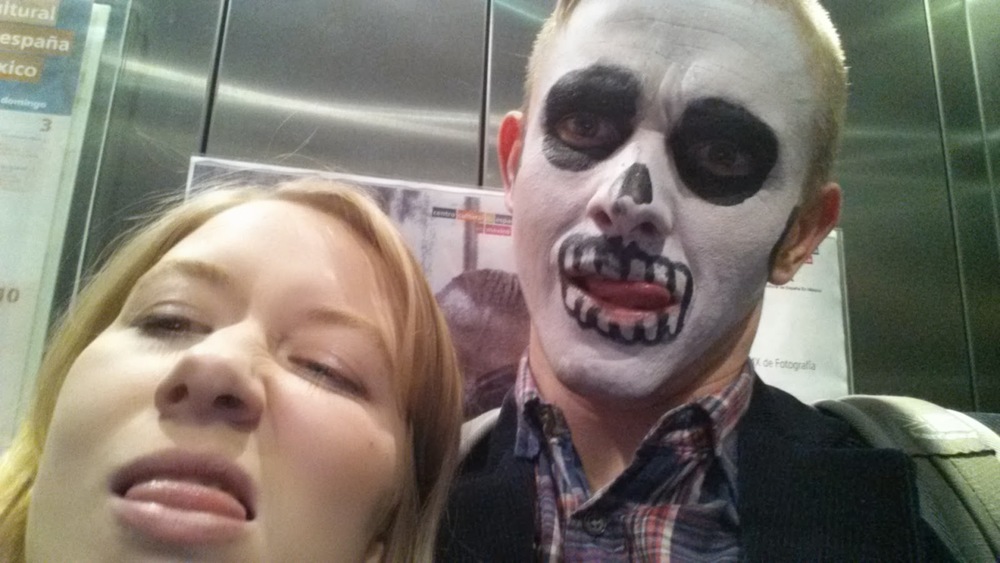
a near hour long showcase at the Centro Cultural de Espana en Mexico, as part of Festival Expandible, on the day of the dead itself. we worked it out that afternoon, but lots to take from it.
Enemies Slovakia videos
Peter Milcak http://www.youtube.com/watch?v=MfSQAdxKts0
Martin Solotruk http://www.youtube.com/watch?v=p3Isb4wuVyM
Saradha Soobrayen http://www.youtube.com/watch?v=0GYhH3HvJ_s
Chrys Salt http://www.youtube.com/watch?v=yLpamPFLhAc
Francesca Lisette http://www.youtube.com/watch?v=F1mehE70l74
JT Welsch http://www.youtube.com/watch?v=YsS06j8gPLI
Pascal O'Laughlin http://www.youtube.com/watch?v=ag8nquGjjZY
Doug Jones http://www.youtube.com/watch?v=Ypi1L1ExqAA
David Vichnar http://www.youtube.com/watch?v=teNnKrO2lAA
Louis Armand http://www.youtube.com/watch?v=hTSkm31JzSI
Sarah Hesketh (& Cristina Viti) http://www.youtube.com/watch?v=gpLyGuU2kic
Mark Waldron & Martin Solotruk http://www.youtube.com/watch?v=84klLN9kNXc
Peter Milcak & Stephen Watts http://www.youtube.com/watch?v=ZhCVTxaNEPo
Red Claw: the 4th of the Pugilistica boxing/art performances
The first pugilistica performance was about deterioration, the second repetition, the third sound, and the now the fourth. Light.